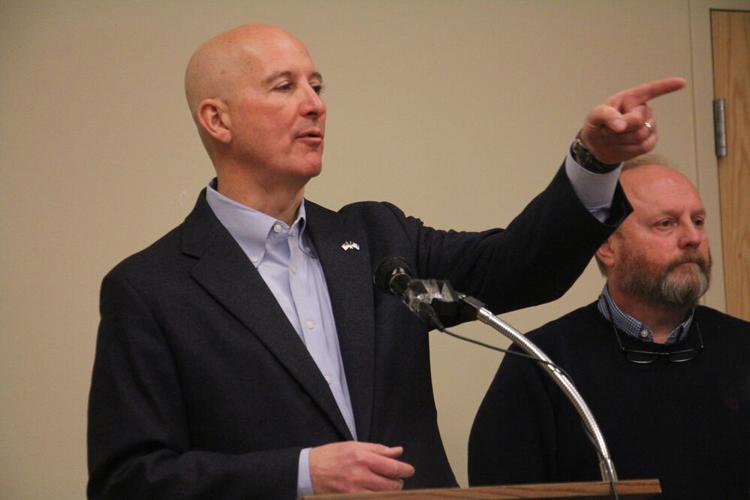







Nebraska Gov. Pete Ricketts calls on an audience member during the question-and-answer portion of his town hall on Tuesday.
Nebraska Gov. Pete Ricketts visited the Legacy of the Plains Museum in Gering on Tuesday to present some of his legislative plans to constituents. For this town hall, the second of a ‘Water and Taxes’ series, he focused primarily on water resource use and a trio of tax relief plans.
Around 50 people looked on as he began his presentation by discussing the proposed Perkins County Canal project. This canal would run through a portion of northeast Colorado to connect with reservoirs in southwest Nebraska. Such a project is made possible by a 1923 compact between the two states, and Ricketts said its construction is vital for future generations of Nebraskans.
A 1923 agreement states that Nebraska is entitled to at least 120 cubic feet per second from Colorado’s portion of the South Platte River from April 1 to Oct. 15 during the irrigation season. The state is entitled to a minimum of 500 feet per second during the rest of the year, but only if Nebraska builds the canal.
People are also reading…

Gov. Ricketts told constituents to contact their state legislators in order to get them to support legislative policies such as tax relief bills and water resource plans.
“If we do not have this canal and reservoir system, the legal minimum that Colorado is required to provide us is zero (cubic feet per second). Zero. That means they could take all the water in the South Platte River in the winter and not provide us with any,” Ricketts said.
He said the canal is especially important because the Coloradoan legislature is developing 283 different projects to control their water supply and limit excess outflow to support their growing population. Colorado Senate Bill 22-126 would put a greater focus on projects that affect the outflow of the South Platte River. According to Ricketts, such efforts could limit the river’s flow into Nebraska by as much as 90 percent.
Dennis Strauch, a former chairman of the Nebraska Natural Resources Commission, said the canal would be crucial to irrigation efforts in the region. He also said it was important to protect the natural resources the state needs.

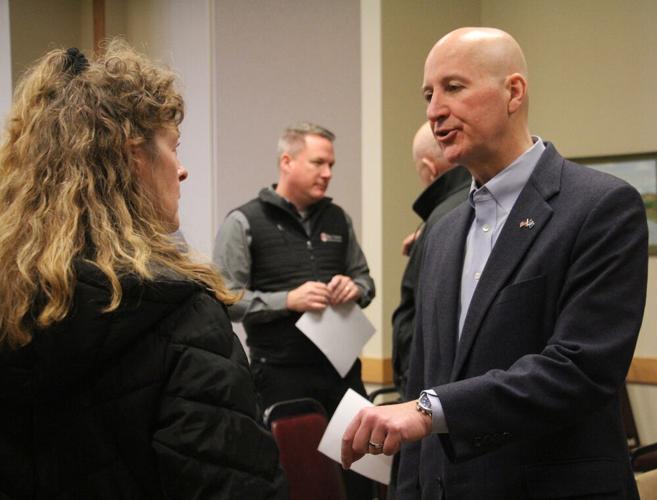
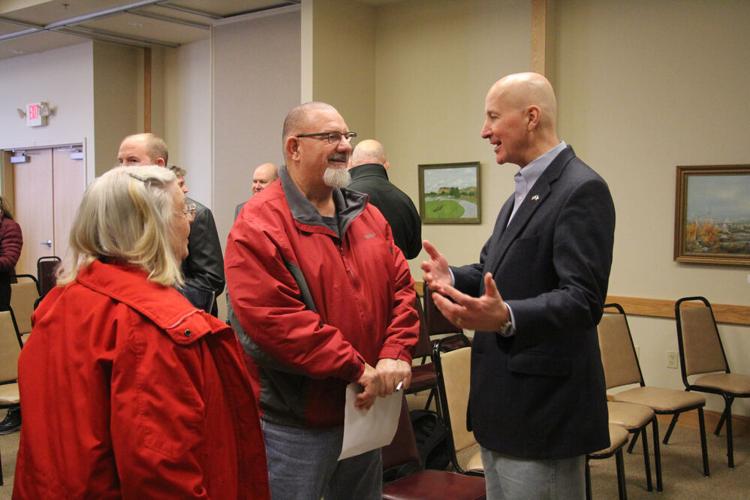
Gov. Pete Ricketts talks with constituents after his 'Water and Taxes' town hall in Gering on Tuesday, Feb. 15. The governor spent the first half of the event presenting legislative issues and spent the second half taking questions from the audience.
“I appreciate the governor’s efforts in that regard as far as moving that project forward, making sure we get the water we’re entitled to. For our area, you might say the South Platte is not critical, but without flows from the South Platte, downstream needs have to be met from the North Platte,” Strauch said.
Colorado is also mismanaging its section of the massive underground Ogallala aquifer, Ricketts said. While aquifer levels in Nebraska are within a foot of their 1950s amount, the aquifer has been drained by almost 15 feet in Colorado in that timeframe. “So we do a great job here in Nebraska managing our water,” the governor said. “Our farmers and ranchers are the original conservationists.”
Ricketts also advocated for projects from legislative speaker Mike Hilgers’ Statewide Tourism and Recreational Water Access and Resources Sustainability (STAR WARS) committee. These projects aim to increase tourism in the state by creating new water-based tourist destinations, including a new marina at Lake McConaughy and a 4,000-acre lake between Lincoln and Omaha. He also supported a $23 million repair effort to permanently restore the collapsed Gering — Ft. Laramie Irrigation Districts Tunnel No. 2.

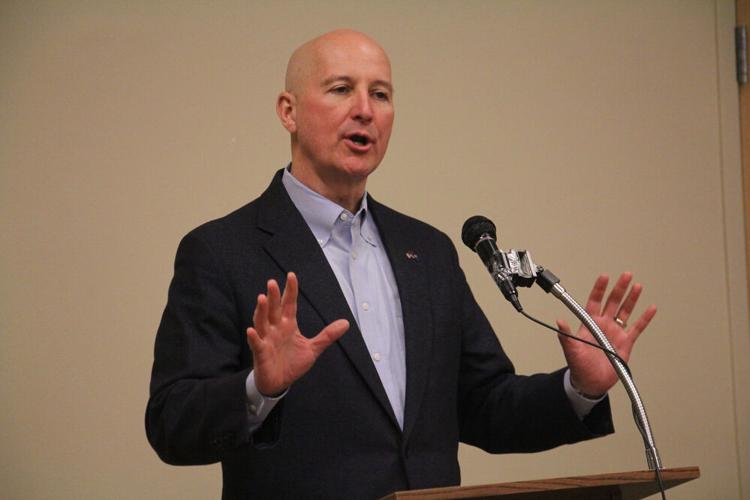
During his town hall event on Tuesday, Gov. Pete Ricketts discussed tax relief legislation and water resource plans for various areas across the state, including renovations for a collapsed irrigation tunnel in Scotts Bluff County.
The second half of the governor’s presentation related to three bills in the state legislature which would advance various types of tax relief. He said these were proposed because the state has more than $1 billion in excess revenue to return to the people.
The first he mentioned, LB 723 would put a floor on an existing $548 million in tax credits so it does not go back down and will continue to provide property tax relief. The next bill, LB 825 would hasten the phase-out of the state’s social security benefit tax from 10 years to five years to encourage seniors not to leave the state.
The third bill he mentioned, LB 939, would lower the state income tax level from 6.84% to 5.84% while lowering business taxes to the same rate. Ricketts said this will make the state more competitive among its peers. Ricketts said the changes would benefit more than 60% of Nebraskan families.
Ricketts invited a pair of local businessmen to the podium to express their thoughts on the proposed tax relief bills. The first presenter was Bytes Computer Solutions president Todd Lewis.
“Tax cuts for me as a business owner would allow me to put more money back into my company, to reinvest into my employees, my infrastructure (and) to grow my organization,” Lewis said. “One of the things we’re running into today is the competitiveness of the employee market. It’s hard to bring new employees into the state. It’s hard to get young people to get back to this area, and any little thing we can do to make that better is going to be a game-changer for us.”
The tax plans would make Nebraska a more appealing place for families, he said. The next speaker was the President of Platte Valley Bank, Zac Karpf, who agreed. Such lowered tax rates would make Nebraska seem like less of an outlier among neighboring states, Karpf said.
After more than half an hour of presenting, Ricketts turned to the audience to ask questions. Most of the audience members asked him to elaborate on the proposals he had discussed during the presentation.
The governor will return to the Legacy of the Plains museum on Friday, Feb. 25 for an ice cream social event from 3 — 5 p.m.