
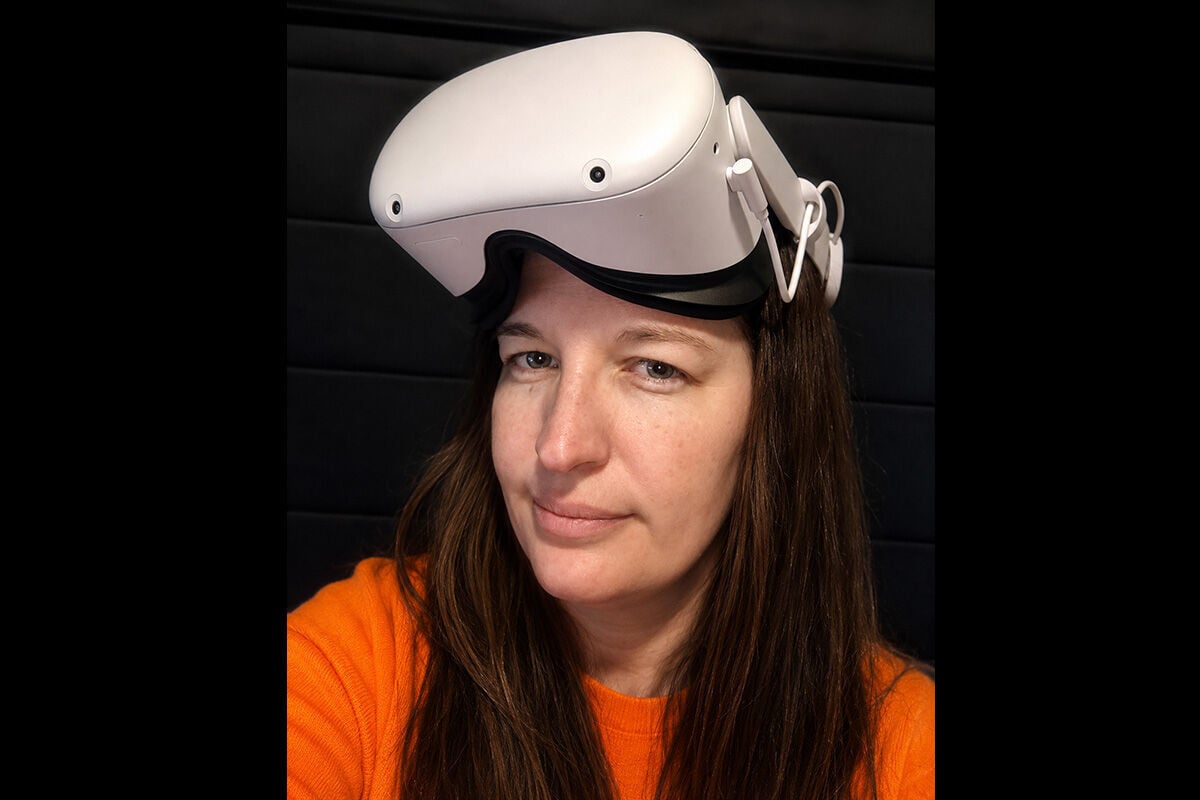
Tess McKinney was sitting in a national conference session on virtual reality in 2019 when she heard something that did not sit right with her. The speaker told the room there was only one company offering VR solutions for healthcare education, and that getting set up would cost a hospital or university hundreds of thousands of dollars.
The speaker’s opinion was not true, and McKinney knew it. She had been working at the University of Nebraska Medical Center's College of Nursing and was deep enough in the VR world to know there were plenty of companies providing VR services for universities. The problem was not a lack of options; it was that smaller companies could not afford to market themselves widely, so healthcare organizations only ever heard about the biggest players in the VR solutions industry.
"I thought, what if there was a free resource that connected everyone?" she said. The response to that question turned into XRenegades, a Nebraska-based consulting company that helps hospitals, colleges, and universities adopt virtual reality, augmented reality, artificial intelligence, and other immersive technologies. McKinney officially started the company in 2022, but by then she had already spent years building VR programs and working in health security and simulation.
People are also reading…
For McKinney, the work has always been about more than technology. She traces her interest in healthcare innovation back to a personal healthcare experience, one that left her thinking deeply about patient outcomes and preventable medical errors. That experience eventually pulled her toward healthcare education, and from there, into immersive technology as a way to let people practice high-stakes situations before they encounter them in real life.
One of her earliest projects used a VR simulation to teach nursing students how to recognize sepsis, a life-threatening condition that can be difficult to catch before it becomes critical. Many students had never encountered it in a clinical setting, but in VR they could practice spotting symptoms and responding to a patient's needs in a near-real environment. Another project she worked on with the UNMC College of Nursing and Global Center for Health Security trained healthcare workers to recognize emerging infectious diseases before outbreaks could spread.
"VR allows people to experience situations they may only encounter once in their careers," McKinney said. "The goal is to prepare them before that moment happens."
A physician in Texas put that idea to the test. He recognized a case of monkeypox after encountering the disease previously in a VR training scenario, and because he knew what to look for, the patient was isolated quickly, helping prevent a larger outbreak. For McKinney, it was proof that immersive learning can have consequences that reach far past the classroom.
Ohio State University was among the first major institutions to take notice, after word of mouth brought McKinney's name to their attention. The university had already invested in VR technology but struggled to get faculty members to actually use it.
"Once people understood how accessible the technology was, everything changed," McKinney said.
From there, the company's services expanded to include hardware sourcing, headset deployment, and grant support, guiding colleges and hospitals from concept to completion as they launch immersive learning programs.
Like many entrepreneurs, McKinney did not have all the answers when she started the business and as her business grew. That is what led her to the Nebraska Business Development Center (NBDC).
"When I started getting the business together, I didn't know what I was doing," she said. "NBDC became the place I could go for answers."
She credits working with Josh Nichol-Caddy, NBDC’s technology commercialization director, for helping her apply and gain approval for a Small Business Innovation Research (SBIR) grant from the National Institute of Health in 2024, and John Hamilton, a statewide consultant with NBDC, for assisting her in creating a comprehensive business plan and three-year financial projections, which led to a Nebraska Business Assistance Act (NSBAA) grant in 2025. The two grants she received, McKinney said, would not have happened without NBDC's help. The funding let her bring on interns and grow the company faster than she could have alone.
"Tess is the kind of entrepreneur every consultant hopes to work with," Hamilton said. "She came to NBDC with an innovative idea, but more importantly, she was willing to put in the work. Our role was to help her organize a plan, identify funding opportunities, and position the business for long-term growth. Seeing XRenegades expanding from a Nebraska startup to serving institutions around the world has been incredibly rewarding."
"Sometimes you just need someone who understands business and can help you work through challenges without spending thousands of dollars on consultants or attorneys," she said. "They're huge cheerleaders. Whenever there's a grant opportunity, funding opportunity, or business resource available, they're reaching out and making sure I know about it."
Clients now range from Nebraska institutions such as UNMC, UNO, UNK, and Creighton University to more than 150 organizations across the country and internationally, and the company maintains one of the largest directories of XR healthcare companies in the industry. Most recently, McKinney began working with Belize's Ministry of Education through a United Nations program to bring immersive technology into K-12 classrooms.
She is just as committed to making an impact closer to home. Through donations, partnerships, and grant assistance, she has helped place XR headsets in 17 Nebraska schools that likely could not have afforded the technology otherwise. Students use them for everything from ATV and electrical safety training to healthcare scenarios and career exploration.
"If we can help students experience something new and open doors for future careers, that's a win," she said.
McKinney is not slowing down. XRenegades is developing new healthcare training tools, including an IV insertion simulation that uses haptic feedback to help nursing students practice procedures in a realistic virtual setting, and expanding its use of AI to support healthcare and education clients. She is also preparing to launch another venture called Go360Live, LLC, a remote collaboration platform using 360-degree video and real-time communication to let healthcare experts guide colleagues from anywhere in the world, potentially bringing specialized expertise to places that otherwise would not have access to it.
Looking back, she said she never expected any of it.
"If someone had told me ten years ago that this is what I'd be doing, I wouldn't have believed them," she said. "But every step led to the next opportunity."