
Young people are often asked what they think.
What happens when we go a step further and give them meaningful opportunities to decide?
That idea is at the heart of Snow-Redfern Foundation’s Changemakers Project, a youth-centered grantmaking program designed to strengthen youth leadership by giving young people a meaningful role in directing resources toward projects, causes, and organizations that matter to them and their communities.
Changemakers is rooted in a simple belief: youth voice should mean more than inviting young people into a conversation after the important decisions have already been made.
We want young people to have opportunities to identify what matters, explore community needs, develop ideas, weigh options, make decisions, and direct real resources.
People are also reading…
Our 2026 Changemakers framework describes the intended outcome as youth-led decision-making about initiatives or projects that impact their community.
Three ways young people can be changemakers
Because meaningful youth leadership can take different forms, Changemakers includes three pathways:
Youth selected
Young people help select the organizations or projects that will receive funding.
Youth directed
Young people identify an issue or opportunity and help design or lead the response.
Youth invested
Young people learn about community needs and philanthropy and make decisions about where charitable resources should go.
These pathways allow the experience to be shaped around the young people and the partner involved rather than requiring every project to follow the same formula.
The organizations and youth leadership opportunities may change from year to year. What remains constant is our desire to give young people experience with leadership as something they can practice now, not simply prepare for someday.
Our 2026 partnerships showed just how many forms that can take.
Civic Nebraska and Nebraska Kid Governor: Turning ideas into action
Through an $8,000 partnership with Civic Nebraska, Changemakers supported youth-led civic engagement connected to the Nebraska Kid Governor program.
The partnership was designed to create opportunities for the Kid Governor and cabinet members to explore leadership, civic participation, philanthropy, and youth-directed decision-making, with resources available to help turn their platforms and priorities into action.
And they did.
Alma organized a hygiene drive that collected more than 600 products. What began as a drive became something more permanent: all three Laurel-Concord-Coleridge schools now have designated spaces where students can access hygiene items when they need them.
Eila created a kindness wall where students could recognize kind things classmates had done for them. One of the things Civic Nebraska highlighted was that the project did more than simply tell students to be kind. It gave them a way to notice and celebrate kindness already happening around them.
Kenzlie organized a school cardboard recycling effort that collected more than 500 pounds of cardboard, engaging classmates, families, school staff, and Waste Management in the process.
Reid started a walking club and fitness challenges and recruited more than 100 volunteer walkers, creating a simple way for people to participate in the healthy-living message he cared about.
Victoria created a public service announcement about the dangers of feeding wildlife and had the opportunity to work with the Nebraska Game and Parks Commission and Spring Creek Prairie Audubon, learning from people who work on the issue professionally.
Will organized cleanups at his school playground and a local park, giving students the chance to work together and immediately see the difference their effort made.
And Nebraska’s first Kid Governor, Charlie, centered her work on cancer awareness, creating educational videos and organizing a drive for Hope Lodge in Omaha. Families across her school district donated hundreds of items to support people staying there while receiving cancer treatment.
Different issues. Different communities. Different approaches.
The common thread was ownership.
As Kenzlie reflected:
“It’s been fun knowing we are all out there and are making a difference for kids across Nebraska. It has been great to be able to share ideas, meet new people, and be part of something that can help our state.”
Launch Leadership: Moving from awareness to investment
Through a $12,000 partnership with Launch Leadership, young people participating in the Advanced Leadership Workshop moved from learning about causes to helping direct real philanthropic dollars.
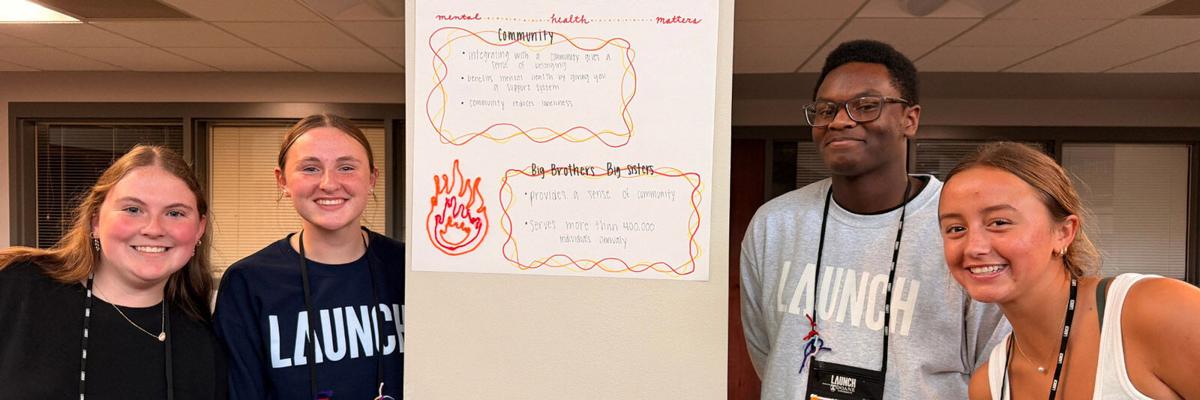
During Launch Leadership’s longstanding Awareness Fair, more than 300 students chose causes they cared about, researched the issues and nonprofit organizations working on them, and developed visual and oral presentations for their peers.
This year, however, awareness came with real decision-making power.
The partnership was designed to give students hands-on experience with community needs, advocacy, presentation skills, leadership, and youth-directed grantmaking.
Students listened to the presentations, considered what they learned, and voted. Launch Leadership then distributed the funding according to those student decisions.
For some participants, the experience came full circle.
Two students who championed the Women’s Fund of Omaha visited the organization and personally presented its check. Launch Leadership described the room as filled with joy and excitement as the students saw where their advocacy had led.
Students supporting The Thirst Project also learned that their award fulfilled approximately one-fourth of the UNL chapter’s annual fundraising goal.
One participant, Madeline Jensen, captured the difference:
“ALW always has had an awareness fair, but this is the first year that I have felt that I have truly made not only audiences care but also made a difference in the world!”
That shift matters.
Students were not being asked to imagine what they might do as leaders someday. They researched, advocated, voted, and helped direct real money toward real organizations.
Empowering Families: Giving the process room to grow
Through a $12,000 partnership with Empowering Families, Changemakers is supporting a youth-centered leadership experience designed to give young people opportunities to explore community priorities, develop ideas, and participate in decisions about what should move forward.
Part of that work has been extended into 2027, allowing additional time for the youth leadership experience to develop.
We think that matters.
Authentic youth participation does not always happen according to a tidy grant timeline. Young people need enough space to understand what is being asked of them, explore ideas, hear different perspectives, and feel genuine ownership of the decisions they make.
Sometimes supporting youth leadership also means being willing to let the timeline serve the participants rather than asking participants to serve the timeline.
Beyond Changemakers: Participatory funding with community leaders
Changemakers is specifically our youth-centered participatory funding model.
But the philosophy behind it influences other parts of Snow-Redfern’s work too.
We believe people closest to a community, issue, or experience often hold knowledge that traditional funding processes can overlook. At times, Snow-Redfern uses special funding to create opportunities for other populations to help make decisions about where resources should go.
In 2026, Snow-Redfern provided $3,000 in special participatory funding through the Nonprofit Association of the Midlands’ Western Nebraska Nonprofit Executive Institute.
During the two-day institute, nonprofit leaders learned about and nominated organizations serving western Nebraska, discussed the nominations with their peers, and collectively determined where the funding should go.
As NAM reflected afterward, the experience did more than move dollars. The conversations increased participants’ awareness of the nonprofit community across the region, strengthened relationships among leaders, and created space for shared discussion about community needs and resources.
One participant described one of the biggest lessons this way:
“Nonprofit leaders need one another.”
That observation captures something important about participatory funding.
The decision matters. But so does what happens while people are making it: sharing knowledge, hearing perspectives they may not have encountered before, wrestling with priorities, and building trust with one another.
Why Changemakers matters
It would be easy to measure Changemakers only by the dollars distributed or the projects completed.
Those outcomes matter.
But the experience of deciding matters too.
Young people are learning how to identify needs, listen to different perspectives, research organizations, advocate for ideas, work with others, weigh limited resources, and make choices that have consequences beyond themselves.
Those are leadership skills.
They are also the building blocks of philanthropy and civic participation.
When young people are trusted with meaningful decisions, philanthropy becomes less abstract. Instead of seeing foundations simply as institutions that decide what matters, they get to experience themselves as part of the process.
They discover:
My perspective matters.
I can help identify what my community needs.
I can ask questions and weigh competing priorities.
I can help decide where resources go.
I can act on something I care about now.
That is why Changemakers exists.
And across Snow-Redfern’s broader work, we are continuing to ask a related question:
Who is closest to this issue, and how might they have a more meaningful role in deciding what happens next?
We do not expect every participatory process to look the same.
In fact, we hope they do not.
Because sometimes one of the most powerful things philanthropy can do is not make every decision itself.
It can share the decision.